
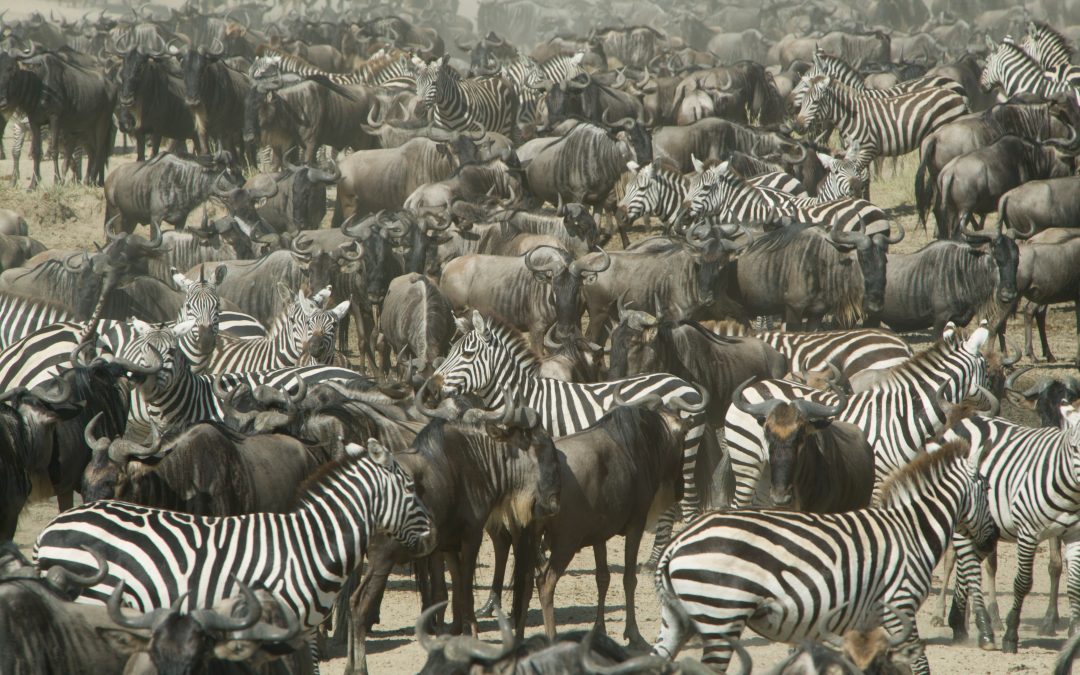
The question most people ask is “When is the best time to see the annual Wildebeest Migration? “ The answer to that is “Now”. With this year’s wildebeest migration in the Serengeti beginning ahead of schedule, you have the opportunity to come now before anyone else.
Home to Africa’s richest resident population of wildlife, you can visit the Masai Mara and Serengeti at any time of year, but if your goal is to see the wildebeest migration then you need to be in the right place at the right time.
The Great Migration is a natural phenomenon, as old as the land itself and one of Africa’s most breathtaking experiences. Seasonal rainfall is the trigger that sparks the mass movement of mega herds in pursuit of the sweet, new grasses that wildebeest love. Since nature sets the schedule, planning a successful migration safari takes experience and excellent local knowledge.
The migration takes a full year to complete a single cycle. That means you can see it throughout the year but because the animals cross huge distances, certain highlights only happen in specific months. For instance, the mass birthing of calves takes place between January and March in the southern Serengeti, while the dramatic river crossings occur between July and August in the far west.
When the rains end in May the wildebeest make tracks for the Maasai Mara. Some take Route One – north across the Seronera Valley. Others swing through the Western Corridor, but for all of them the journey is beset with danger. For a start there are the famous Serengeti lions – about 3,000 at the last count – to which can be added leopards and cheetahs, hungry hyena clans and monster crocodiles.
That is the migration’s normal pattern but this year is different . Lack of rain forced the herds to leave their breeding grounds early, driving them into the Western Corridor two months ahead of time. There, lying in wait for them are the notorious Grumeti River crocodiles. Now, at last, rain has come, the river is high and experts are predicting unparalleled scenes of high drama as the monster crocs take their toll.
Zebras are often the first to arrive in the Mara, chomping down the tall grass with the wildebeest hot on their heels. Here they stay from July to October — the main tourist season – when visitors flock to watch the dramatic river crossings.
But as soon as the rains return the wildebeest head back to the Serengeti, drawn towards their calving grounds in the park’s deep south. In the dry season you will see nothing here but an emptiness of dust and stubble. But between January and March when the calves are born there is nowhere on Earth so vibrantly alive.
Where to go to see the Migration
Tanzania
The best game-viewing areas in the Serengeti are the short-grass plains and their granite kopjes in the south, the Seronera Valley, the Western Corridor and the far north of the park where it meets the Mara. One of the loveliest areas lies in the heart of the park, where the Seronera river meanders across the plains, creating a linear paradise of Senegal palms and fever trees in which to look for leopards.
June is when the migration pours through the Western Corridor into Singita Grumeti, a private game-viewing stronghold the size of the Mara with only 70 guests at a time.
The north of the park between the Lamai Wedge and Klein’s Camp is a wild, broken country of granite kopjes, hidden valleys and open savannah.
Off-track driving is still allowed and the abundance of game is reminiscent of the Mara I knew 30 years ago. During the migration in early November you can watch huge river crossings with fewer vehicles than you will see in the Mara.
Kenya
The Maasai Mara is renowned for the spectacular river crossings that take place when the migration is here from July to November. Some of the biggest crossings occur where the Mara River flows past the Mara Serena Safari Lodge on its hilltop overlooking the plains. The Mara Triangle, the area to the west of the river, has fewer lodges, and therefore fewer visitors at this busy time.
Elsewhere in the reserve you can often witness similar dramatic scenes when the herds gather along the Sand river and the Talek, and with luck you may even spot the Marsh Lions of Big Cat Diary fame hunting zebras near Governors’ Camp.
The best way to avoid the crowds that gather whenever big cats are found is to stay outside the national reserve on one of the excellent private wildlife concessions, such as Naboisho, Mara North and Olare Orok, where visitor numbers are strictly limited. The game viewing is as good as anywhere. So is the accommodation (some of Kenya’s finest bush camps are here), and you can still enter the reserve to watch the river crossings.
For more information visit our Tanzania migration page, add it to your bucket list and we will send you some pertinent itinerary advice.


 STEVE TURNER
 SELEMPO EDWIN LESOINE
 STANLEY KARITHI
 ZACHARY METHU MBUTHIA
 PETER LIECH ADEDE
 FELIX WAMBUGU
 JOSHUA SONKOYO
 HENRY MIWANI


