

Discover the beauty of Africa and experience the world’s most spectacular wildlife event as herds of Wildebeeste, Zebras and Antelopes roam the vast savannah eco-system that stretches from Ngorongoro Crater to The Maasai Mara. We can guarantee your safari is at the heart of the migration, with the option of a classic mobile tented camp that moves with the herds and the seasons.
The Great Migration is rated as one of the world’s most spectacular natural events – every year over a million wildebeest, zebra and antelope migrate clockwise around the Serengeti-Masai Mara ecosystem, taking in two different countries and making time for birthing, courting and mating on the way. This mass exodus is not only noted as a wonder of the world, but is always a great opportunity for people to witness nature at its best. You can witness the drama unfold as predators lurk in the bushes and prey scamper for safety in what has since been dubbed ‘survival for the fittest’.

The most notorious among the predators is the lion and the Nile crocodile. The lion perfectly chooses its arena – the grassy Mara plains. In the plains, the lion is shrouded in thick grass cover and gets a strategic hiding spot to attack unsuspecting wildebeest and zebras. During the peak of the migration, vultures circle the air and hyenas laugh in the shadows; an indication of the innumerable wildebeest and zebra that have fallen under the claw of the mighty African lion.
The Nile crocodile however takes the medal as the deadliest predator. It comes in at the climax of the Mara migration – the crossing of the Mara River! This avid killer shapes the events that take place during the crossing of the Mara River. From the splashing waters and floating wildebeest bodies, it is the match-maker.
Crocodiles are known to kill by drowning. When it spots a potential victim, it clutches the prey in its strong jaws and pulls it beneath the water surface. In the process, it ferociously twists and turns its head. This shreds its prey into pieces and suffocates the life out of it.

The start of the wildebeest migration
The African animal exodus begins between January and March in the Serengeti and Ngorongoro Conservation area, where the calving season brings forth a record of 500,000 new calves.
Enormous herds of wildebeest and zebras can be seen grazing on rain-ripened grass. As the food supply quickly diminishes, the herds are forced to head to the long grass plains and woodlands of the Serengeti’s western corridor near Lake Victoria. Here, the animals divide, with some swinging further west and others heading northwest. They will meet up again in the Maasai Mara of Kenya.
April to July is a transitional period between the rains and the dry season and the wildebeests start moving north towards the Maasai Mara for greener pastures. As they go, they attract numerous predators such as lions, cheetahs and hyenas. They are all heading to the next watering point, the Mara River.

The spectacular wildebeest movement
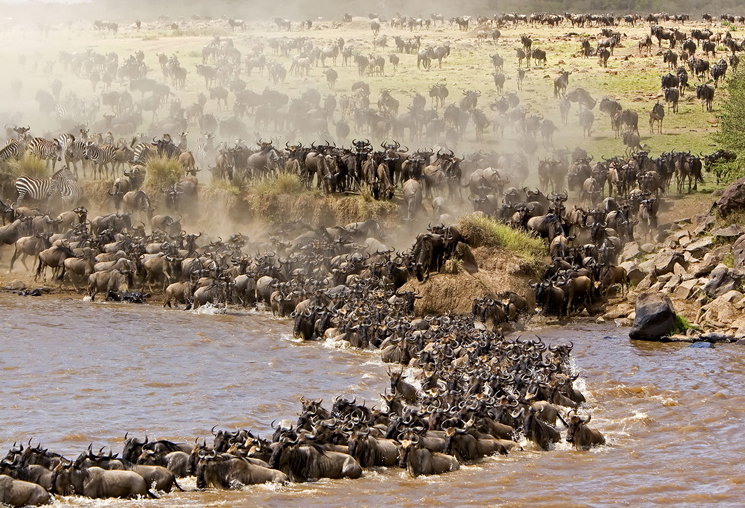
From July to October, the grazing animals take a four-month-long trek towards the Mara River. In desperate need of water to drink and grass to graze, the countless herds need to cross the river to reach the lush, green grasslands in Maasai Mara. The world’s most spectacular sights truly happen at the mass crossing of the swollen Mara River.
Depending on the amount of rainfall, the chosen crossing place is usually shallow enough to allow the majority of the herd to cross safely. However, most of the river is deep and fast flowing, with steep banks on either side. Many of the weaker animals are swept away by the strong river currents or are trampled by the stampede of the other wildebeest as they swim. Hundreds of animals die during the crossing. The close-following predators are always in for a treat at this time of year.
The best place to view the wildebeest expedition is at one of Kenya’s strategically placed safari lodges, but some Tanzanian lodges that also offer a great view of the wildebeest crossing during this time.

The wildebeest exodus
In November, the short rains call the migration southward, back to the Serengeti. About 250,000 wildebeest die during this 1,800 mile journey due to predator attacks, exhaustion and sickness. Although the trek culls most of the old or very young wildebeests from the herd, the next calving season will produce another 500,000 new calves to continue Kenya’s great “Seventh Wonder of the World”.
You can enjoy the adventurous experience of a Wildebeest Migration Safari in Kenya or Tanzania with professional guides in open-topped, 4WD vehicles and first-hand tours to remote villages of the neighboring communities. The wildebeest migration is definitely a must-see Kenyan attraction and a great reason to go on a safari in Kenya.

The masaai people and the migration
The Maasai people of Kenya also add an allure and incredible twist to the wildebeest migration. At the time when the herds make an entry into the Maasai Mara, the plains are usually graced with green vegetation, which is a good time for the Maasai to come out and feed their animals with greener pastures.

Where to book your Kenyan or Tanzanian wildebeest migration safari tour
The wildebeest migration is ultimately one of the most popular times to go on an African safari tour. One of the options we recommend our visitors are these profiled trips:
Big Game Safari, Kenya
Migration Safari, Tanzania
You can find more information about these trips on:
https://originsafaris.com/special-group-departures-2017-18/
You can also book through our local office and enjoy a guided Kenya wildebeest migration tour upon your visit to Kenya or Tanzania via https://originsafaris.com/
At Origins Safaris we have over 50 years of authentic African safari experience and we are passionate about wildlife, cultural heritage, adventure & exploration. We customize each and every safari to your personal requirements and expectations, ensuring an exclusive, unique and authentic experience every time.
SafariLIVE
The migration is currently in full swing – we have seen big river crossings of wildebeest and zebra and it’s an exciting time to be in the Maasai Mara.
SafariLIVE are filming live from the Maasai Mara every week in conjunction with Nat Geo Wild. You can watch the LIVE safari adventure every Friday night at 11PM EST on Nat Geo Wild for the next 4 weeks. You can also watch the episodes live on safariLIVE’s YouTube channel @ 5am CAT each Saturday. Here are the links to watch live:
https://www.youtube.com/watch?v=mgMNGX43m2I&app=desktop
You can also watch the episodes of safariLIVE on Nat Geo Wild’s website. Here is the link to SafariLIVE on the Nat Geo Wild’s Website:
http://www.nationalgeographic.com/video/safari-live/
If you would like to ask the team questions live you can ask them live on twitter using the #safarilive.
https://originsafaris.com/serengeti-migration/
Origins Safaris – Authentic African Experiences Since 1963


 STEVE TURNER
 SELEMPO EDWIN LESOINE
 STANLEY KARITHI
 ZACHARY METHU MBUTHIA
 PETER LIECH ADEDE
 FELIX WAMBUGU
 JOSHUA SONKOYO
 HENRY MIWANI


