
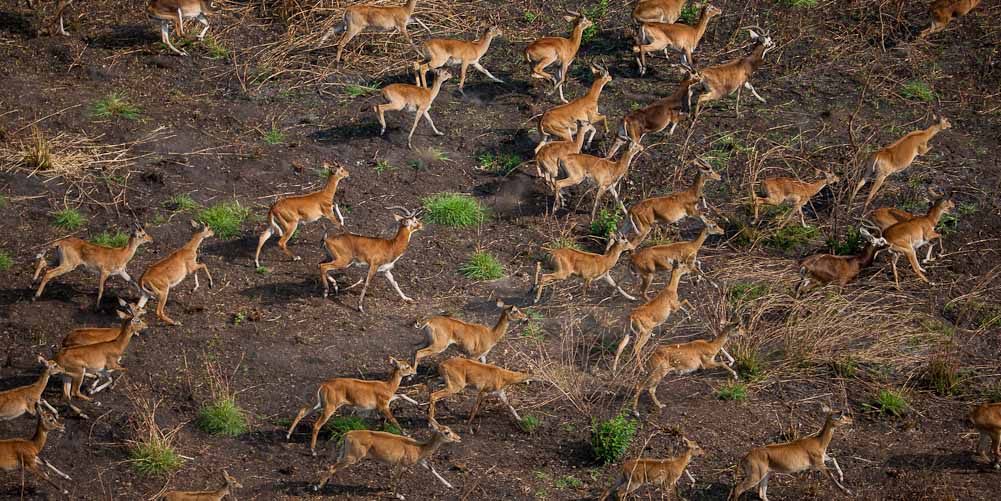
The Sudd wetlands of southern Sudan and the Ethiopian region of Gambela, is home to an astounding number of white-eared kob and to Africa’s second largest mammal migration. From March, it is the beginning of one of the greatest wildlife spectacles on Earth. At least 1.2 million antelopes converge on a vast savannah east of the White Nile. This mass movement of tiang and the white-eared kob easily rivals the Serengeti’s teeming masses of wildebeests – the biggest migration of land animals in the world.

Join us on some of the most pioneering expeditions and be one of the first and only modern-day adventurers to penetrate these road-less and inaccessible swamps.
The Sudd
The Sudd is a vast swamp in South Sudan, formed by the White Nile’s Baḥr al-Jabal (meaning “Sea of the Mountain” in Arabic) section. The Arabic word sudd is derived from sadd, meaning “barrier” or “obstruction”. The area which the swamp covers is one of the world’s largest wetlands and the largest freshwater wetland in the Nile basin.

The Sudd stretches from Mongalla to just outside the Sobat confluence with the White Nile just upstream of Malakal as well as westwards along the Bahr el Ghazal. The shallow and flat inland delta covers an area of 500 km (310 mi) south to north and 200 km (120 mi) east to west between Mongalla in the south and Malakal in the north.

Its size is highly variable, averaging over 30,000 km2 (12,000 mi2). During the wet season it may extend to over 130,000 km2 (50,000 mi2), depending on the inflowing waters, with the discharge from Lake Victoria being the main control factor of flood levels and area inundation. Since the Sudd area consists of various meandering channels, lagoons, reed and papyrus fields and loses half of its inflowing water through evapo-transpiration in the permanent and seasonal floodplains, the complex hydrology has many primary and secondary effects.
Flora & Fauna
The Sudd wetlands comprise a complex maze of ecosystems, ranging from open water and submerged vegetation to floating fringe vegetation, seasonally flooded grasslands, rain-fed grassland and finally, floodplain woodlands. The Sudd is recognised for their unique ecological attributes that include a large population of resident and Palaearctic migratory birds. Over 400 species of bird are found here, including Great White Pelican, Black Crowned Crane, White Stork, Black Tern and the largest population of Shoebill stork in Africa with an estimated population of 5,000. It forms part of the East-Asian/East African flyway of Palearctic birds, linking breeding ranges in central-Europe and Asia with winter ranges to the south. A large number of inter-African bird migrants also rely on the Sudd and surrounding habitats as a dry season refuge.

As the surrounding landscape is a large swath of dry Sahel across Africa, the swamps, flood plains and grasslands support various endangered mammalian species, especially antelopes such as the endangered Nile lechwe, tiang, Mongalla gazelle and the world’s largest population of white-eared kob. These antelopes make large-scale migrations (approximately 1.2 million) over the relatively undisturbed habitat of the Sudd. Other notable wildlife species include elephant, buffalo, reedbuck and sitatunga. If you keep a keen eye you will also be able to see crocodiles and hippos lounging in the shallow waters.

Gambela National Park
Gambela National Park is the largest of the national parks in Ethiopia, covering 5,061 km2 (1,954 mi2). It was established as a protected area in 1973 to conserve the diverse assemblage of wildlife and unique habitats. Although it is not technically in the Rift Valley, Gambela National Park lies along another of the country’s important rivers – the Baro.

The park is situated in a lowland plain, but there are some areas of higher, often rocky, ground with deciduous woodland and savanna, as well as large termite mounds. Gambela National Park also supports extensive areas of wet grassland and swamps.

Flora and fauna
This remote and swampy park is teeming with a wide variety of wildlife. Some 69 species of mammal are protected in the park. The park is a strong hold for the endangered Nubian giraffe, Nile lechwe and Lelwel hartebeest. Other mammal species reported to be living here are lion, leopard, buffalo, cheetah, hyena, warthog and elephant. There are a few primate species such as the olive baboon, patas monkey, guereza monkey, Ethiopian white whiskered vervet monkey and the black and white colobus monkey. The park is well known for the large herds of white-eared kob, Kafue Lechwe, Blue wildebeest, Greater kudu, taing, Burchell’s zebra, bushbuck, orbi, reedbuck, and waterbuck, among others. The Baro River is host to hippo, crocodile and 92 species of fish, with Nile perch weighing up to 100kg.

In recent years, Ethiopia has rightly become one of Africa’s leading birding destinations. Its avifauna represents an interesting mixture of eastern and West African, Palearctic and endemic components. There are 372 species of birds recorded in the park and are both plentiful and easy to spot. The park includes Ethiopia’s only population of Shoebill. Other species in the area are Uelle Paradise Whydah, Red-throated Bee-eater, Little Green Bee-eater, Egyptian Plover, Pygmy Sunbird, Black-faced and Bar-breasted Firefinches.

66% of the area is considered shrubland, 15% is forest, while 17% has been altered by man. In the wet grassland and swamps, the native grasses grow over 3 metres (9.8 ft) in height.
About the White-Eared Kob
The white-eared kob is a medium sized, chestnut coloured antelope that is most prominent in The Sudd wetlands of southern Sudan as well as in the protected area of Gambela National Park. These graceful antelopes of central Africa’s well-watered savannas and floodplain grasslands are best known for their annual migration, which produces one of the natural world’s great spectacles.

Seasonal Migration
The Sudd wetlands of Southern Sudan, nurtured by the White Nile, are home to the world’s largest population of white-eared kob. From March until June, the animals move en masse south and east, from the floodplains of the Sudd and Bandingilo National Park across to Boma National Park and into Gambela National Park in Ethiopia. Keeping ahead of the rains they are joined by other antelopes -the tiang and Mongalla gazelles. The scale of this seasonal wildlife migration is said to rival the wildebeest herds of the Serengeti, with as many as 1.2 million animals simultaneously on the move. Thickly packed columns of these animals in motion can stretch a staggering 80 km (50 mi) long and 48 km (30 mi) across. In the dry season months from November to January, the direction of the migration is reversed. The animals return in search for nutritious grasses, watered and made rich by the silt left behind by the flooding of the White Nile.

This awe-inspiring mammal migration is truly an experience you do not want to miss!
About Origins Safaris
At Origins Safaris we are passionate about wildlife, cultural heritage, adventure and exploration. We customize each and every safari to your personal requirements and expectations, ensuring an exclusive, unique and authentic experience every time.
Origins Safaris is a family business, founded in 1963 by Don and Margaret Turner. It is managed today by two subsequent generations of the family, and predominantly by Don’s son, Steve. We are so much more than just a travel broker – our years of experience, professionalism and reliability means that we go the all important extra mile, to make sure your dream safari is safe, memorable, educational and most of all great fun. We are renowned for our meticulous safari planning from start to finish, and the highest standards of natural history.

Origins Safaris provide that crucial “sound advice and impeccable service” so seldom found by other companies. We have 50+ years of authentic African safari experience and the know-how to make your trip run as smoothly as possible.
Use our website (www.originsafaris.com) to find the trips that inspire you and add them to your bucket list. As you use the arrows to browse through the various countries we do safaris to, bear in mind that the further you go into the website the more adventurous, specialized and remote the trips become. We are offering you a lifetime of travel, beginning with the easiest and ending with the hardest as you find your Africa feet and wish to do more exciting trips.
The Sudd migration safari to Gambela is one of the most recent pioneering expeditions. It is a magical place to visit, and something that you will probably only see once in a lifetime.
If you would like to travel to Gambela and experience the Sudd migration highlighted above, please contact us on the following: https://originsafaris.com/sudd-migration-ss/
Origins Safaris – Authentic African Experiences Since 1963


 STEVE TURNER
 SELEMPO EDWIN LESOINE
 STANLEY KARITHI
 ZACHARY METHU MBUTHIA
 PETER LIECH ADEDE
 FELIX WAMBUGU
 JOSHUA SONKOYO
 HENRY MIWANI


