
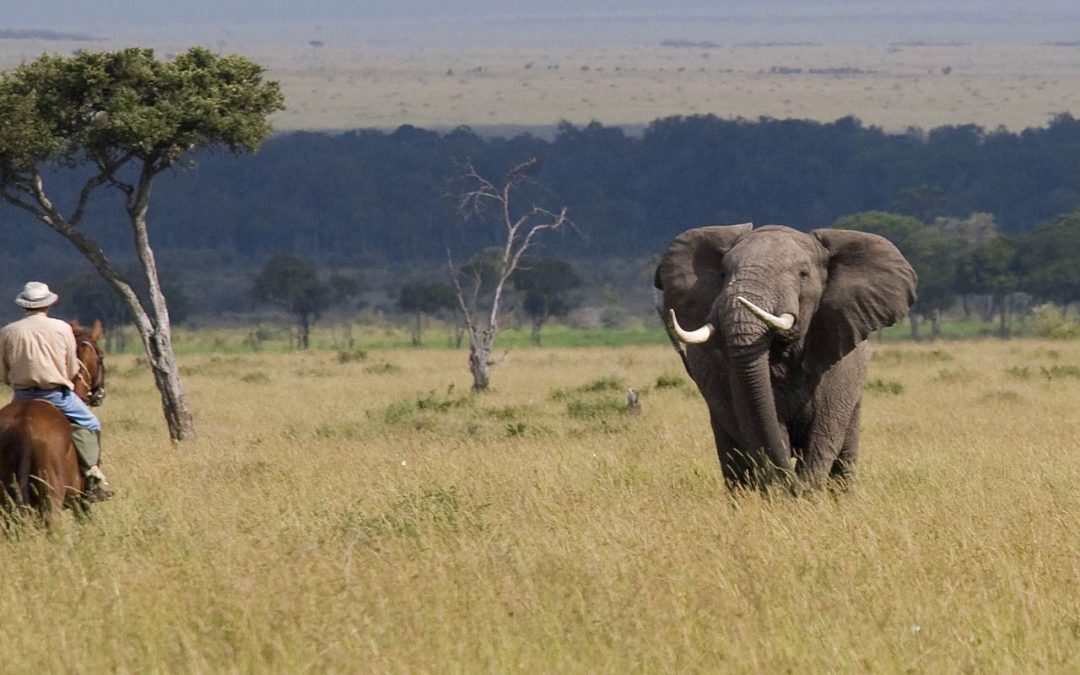
In most people’s minds the concept of the ‘African Safari’ probably evokes the idea of game viewing by vehicle, and indeed this is likely to remain the most popular activity undertaken in East Africa. But going on ‘Safari’ doesn’t have to mean driving around in an open-topped or open-sided vehicle. Walking, riding or boating lets you connect with the bush in a completely different way. Not all parks offer the chance for walking, riding or boating, but in those that do, be sure to take advantage of these opportunities. Experiencing the bush on foot, on a horse or in a boat is an unparalleled experience.
You will hear more, smell more and see more – not necessarily large animals, but the subtleties of the bush. For walking safaris, being really out there, without a vehicle between you and the ground, lets you connect in a much more profound way with the wildlife and environment.

Walking and riding safaris are probably one of the most exciting and in-demand activities in the African bush, together with conventional game viewing by vehicle. These experiences provide indelible memories of the scents and sounds of wild Africa. Boating safaris are wonderfully refreshing, dust-free and generally beautiful.

After all, can there be anything to compete with the thrill of getting up close to really big game, such as buffalo, hippo, leopards, lions and elephant – all from the safety of your vehicle? Well, yes – and it’s the thrill of taking to your feet in the bush, in exactly the same kind of habitat, but without the feeling of protection afforded by a vehicle. Here you will be down at the same level as the wildlife, sharing its environment, not spectating at it, and experiencing the scents and sounds of wild Africa. There is little to beat the way that adrenaline courses through your body as you experience tracking big game on foot.

Perhaps the most significant way of describing a walking or riding safari, in contrast to conventional game viewing, is that, while the latter is a holiday, the former is an adventure! Undoubtedly you will remember the walking / riding part of your experience in Africa long after the memories of game sightings have faded away. Essentially you will feel that you have been an integral part of the life of the bush, not just observing it.

KENYA
“Jambo na Karibuni” (Hello & Welcome) – This friendly Swahili greeting will be your introduction to all the new friends and acquaintances you make on safari in Kenya. Kenya is rightfully described as “All of Africa in One Country”, and it is exactly that. It is a fact that Kenya enjoys some of the world’s greatest environmental diversity resulting in unparalleled species and sub-species varieties.

Kenya is known for its safaris, diverse climate & geography, expansive wildlife reserves and national parks. Kenya is simply the best wildlife viewing destination in Africa. People from all over the world are drawn here by its essence: the chance to immerse yourself in the spectacle of the big game: the predators and the prey ritually entwined in a cycle of life and death. Kenya boasts every known landform and a wealth of animal and bird life which owes its very existence to the contrasts in the country’s terrain. You do not have to be an ornithologist to enjoy its one thousand species of birds or a zoologist to be amazed by its variety of animals. Kenya’s birds range from the beautiful to the bizarre and its wildlife from the weird to the wonderful.
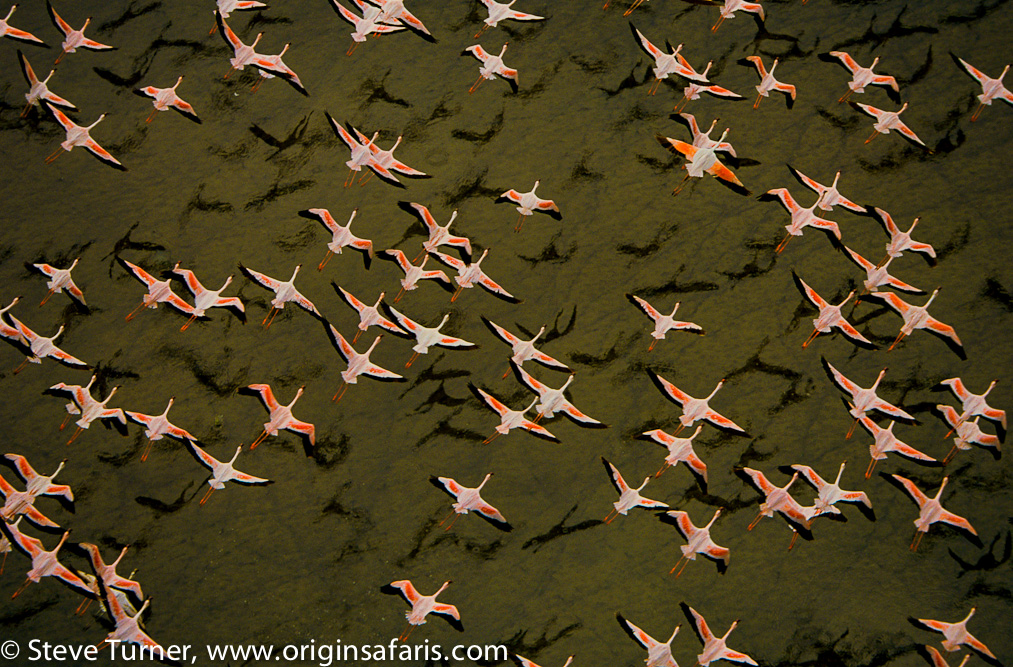
The “Big Five” game animals of Africa, that is the lion, leopard, buffalo, rhinoceros and elephant, can be found in Kenya and in the Masai Mara in particular. A significant population of other wild animals, reptiles and birds can be found in the national parks and game reserves in the country. The annual animal migration occurs between June and September with millions of animals taking part, attracting valuable foreign tourism. Two million wildebeest migrate a distance of 2,900 km from the Serengeti in neighbouring Tanzania to the Maasai Mara in Kenya, in a constant clockwise fashion, searching for food and water supplies. This Serengeti Migration of the wildebeest is a curious spectacle listed among the Seven Natural Wonders of Africa.

Walking in Kenya
A number of Conservancies have been established, quite independent of the National Park systems, which allow walking and riding safaris. Often these Conservancies are actually attached to National Parks – as in the Maasai Mara – or may instead be totally free-standing. However the big difference, is that there are no irksome government restrictions placed on these areas – and therefore walking / riding safaris (together with night drives etc) can freely take place here. You might ask whether the amount of game to be seen is as good. The answer is that it is usually at least as good. There are no natural boundaries between the National Parks and their surrounding Conservancies, and the game often appears to be relieved to be able to get away from the crowds of tourists! Even where the Conservancies stand on their own, they have successfully been populated with an abundance of game.

Different grades of walk can be arranged in each case to suit whatever degree of exertion is desired by each guest. Each different kind of habitat within the Conservancy is visited, before travelling on to your next destination. Depending on the time of year, you may walk for 3-5 hours, returning to camp only when it really gets too hot to walk. The first half an hour or so is often described as ‘reading your daily newspaper’, as you study the ground in front of you, to deduce what wildlife has passed by overnight. Indeed there is a story to be told in virtually every track and dropping that you will come across.

Your guide will have an encyclopaedic knowledge of where you will be walking (in most cases he was brought up here), and will delight in explaining how so many plants and trees can be used for local medicines, and in teaching you how to identify droppings, distinguish the different tracks, and so on. He may even show off his skills by creating a camp fire using just a couple of pieces of (carefully chosen) wood, for your mid-walk tea break.

Camel Walking Safaris in Laikipia
These are walking safaris supported by camels. These trips offer a unique perspective of not just the animals but the land they live in. On foot you will fine tune your senses and experience the country in vivid and exciting detail. These safaris thrive on adventure and an old fashioned approach to safari. The train of friendly camels carry the comfortable mobile camps to remote and splendid locations each day.

These camel walking Safaris traverse the beautiful country with geologic structures of immense age that tell stories of a turbulent and rich history beside the Rift Valley. Archeological artifacts like flints, shards, graves and pottery litter much of the ground near our camps and in all this evidence are fascinating stories of an equally turbulent cultural history.

The rich wildlife in Laikipia distinguishes it for its diversity of large mammals, the greatest in Kenya. Besides the Elephants, the big cats and all the remaining large predators, the endangered species thrive here too like the Grevy’s Zebra, Wild dogs and Highland Hartebeest.

Adventure Riding Safaris…Taking You Off the Beaten Track
Riding up close to elephants, lions and buffalo, or galloping with wildebeest and zebra, are truly life changing experiences. If you are a rider, there is simply no better way to see Kenya than from the back of a well-schooled and fit horse. Horseback holidays are the ultimate, unique and exciting adventure safaris in Africa.

Journeying through the open plains of Kenya on solid crossbred horses offers an unrivalled African experience to see abundant wildlife and habitats off the beaten track. On horseback, you can make your way down narrow gorges to discover a lush valley filled with wildlife, or gallop alongside herds of wildebeest during the migration.

These safaris ride across the Masai Mara and Amboseli, choosing the best routes. With a mobile tented camp that moves with you, this is the epitome of what a true ‘safari’ is all about.

ETHIOPIA
Ethiopia is a multi-dimensional experience – it is like nowhere else on the planet, a beautiful country blessed with a peerless history, fabulous wildlife and some of Africa’s most soulful people. Ethiopia has all the essential elements that call travellers back here time after time – wildlife you just don’t find elsewhere, epic landscapes of rare beauty, an endlessly fascinating historical tales that provide depth and context to any journey through the country.

Bale Mountains National Park
The Bale Mountains National Park is known for its wildlife more than any park in Ethiopia. It is located in the south-east part of Ethiopia, 400km from Addis Ababa. The park protects over 2,200km2 of pristine plains, woodlands and bush land. Due to the wet and overall mild climate, with great variation in altitude makes the Bale Mountains an extraordinary habitat. Divided into grasslands, woodlands, afro-alpine meadows, the Erica moorlands and Herrena forest, it is home to great welts of Juniper tree, wildflower, St Johns’s, Wort, shrubs, to the Sanetti Plateau – an enormous area covered in lichen covered rock, of streams and lakes, an expanse periodically punctuated by Giant Lobelia.
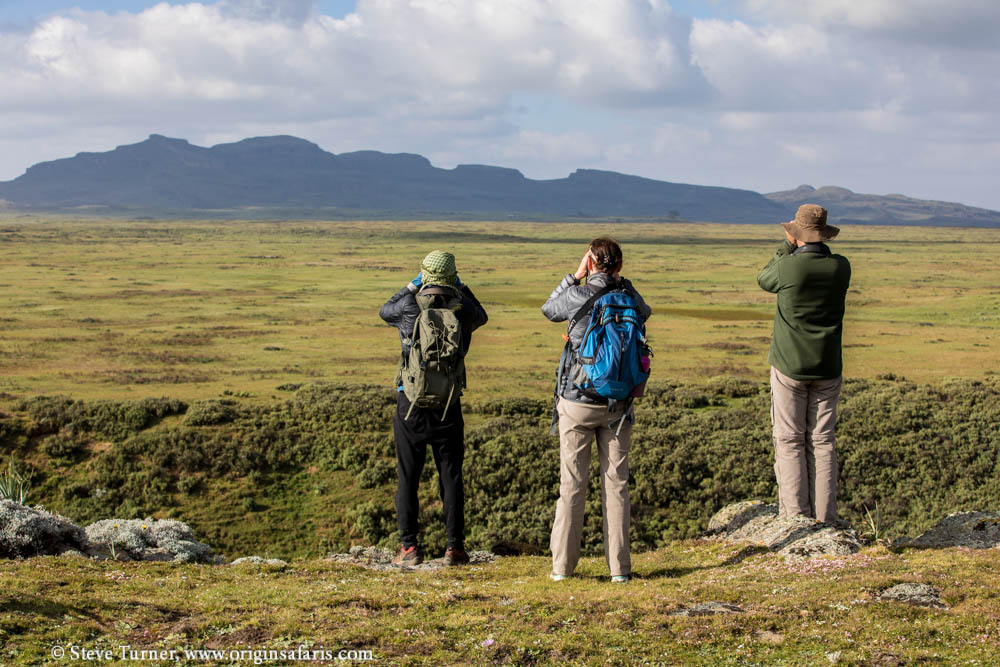
The park is home to a multitude of unique flora and fauna species, harbouring 20 animals endemic to Ethiopia, of which 5 mammals are found here. Those of paramount importance include the Bale monkey, Mountain nyala, giant mole rat and the Ethiopian wolf. The Sanetti Plateau and the Web Valley in the Bale Mountains National Park is home to about half of the world’s population of Ethiopian wolves (between 400-450). This beautiful creature is the rarest candid on the planet and Africa’s most endangered carnivore. Other species of mammal include the Menelik’s bushbuck, spotted hyena, African wild dog, exceptionally shy lions and the rare black leopard – all in extremely low numbers. Overall, there is a high incident of rodent species, several of which are keystone features of the food chain – which accounts not only for the presence of the Ethiopian wolf, but also for the area’s large numbers of raptors. Indeed bird-wise, the area is extremely rich, with over 280 species thus far identified.

For hikers, nature lovers’, birders and wildlife watchers, the Bale Mountains National Park is a must!
Riding With Wolves
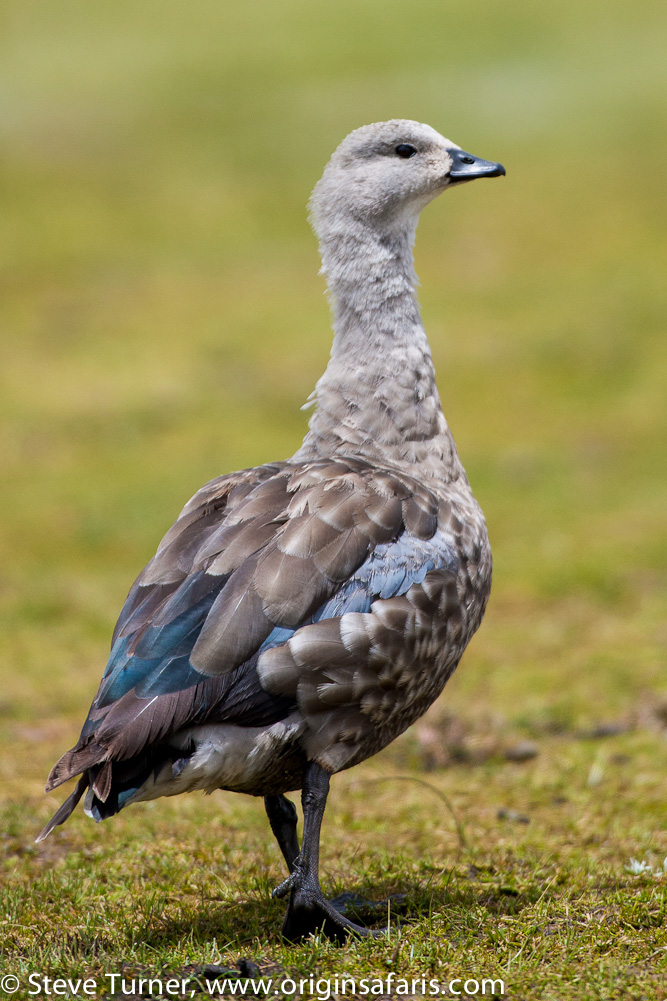
Discover the Ethiopian Highlands on local mules, riding in traditional style through the various eco systems and the dramatic landscape of the Web Valley. Here you can see Mountain Nyala, Menelik’s bushbuck and an abundance of endemic birds such as: Blue-winged goose, Chestnut-naped Francolin and Rouget’s Rail. However, the star of the Bale Mountains is undoubtedly the Ethiopian wolf. With its thick, brick red coat on top and white belly below, its narrow snout and lithe body, it looks similar to a large fox or a jackal. Chances of locating and observing the wolves are high.

Walking Through the Bale Mountains
The Bale Mountains are excellent for hiking! Only about 200 people a year trek in the Bale Mountains, so you will have this exquisite landscape to yourself. To the south of the Bale Mountains National Park lies a 1200m escarpment, below which is one of the largest and most extensive forests remaining in Ethiopia, the Harenna Forest. The slope of the southern escarpment falls rapidly from the tree line at 3200m to around 2000m within a distance of only 8 km, producing a rapid and spectacular change in landscape, habitat, and species composition. The Harenna forest holds 3% of Africa’s remaining bamboo forest. Living in this dense bamboo forest is the rare and endemic Bale Monkey which can be seen swinging in the trees. Recent sightings include Giant Forest Hog, Ververt monkeys, Olive baboons and Menelik’s bushbuck.

For bird-lovers, the forest supports the endemic Ethiopian Cisticola, the Abyssinian Slaty Flycatcher, the Abyssinian Catbrird, the Black-headed Siskin and other colourful varieties such as the Yellow Fronted Parrot and Black Winged Lovebird. The Harenna Forest is truly a magical place to explore.
No trip to the Bale Mountains would be complete without spending time hiking on the Senetti Plateau. This dramatic and ethereal lunar landscape is the world’s largest expanse of Afro-alpine moorland. This montane habitat elevates between 2,800m and 4,377m above sea level. The area is mixture of amazing ‘moonscapes’, lakes and waterfalls, covered with rare Erica shrub and scattered with Giant Lobelias.
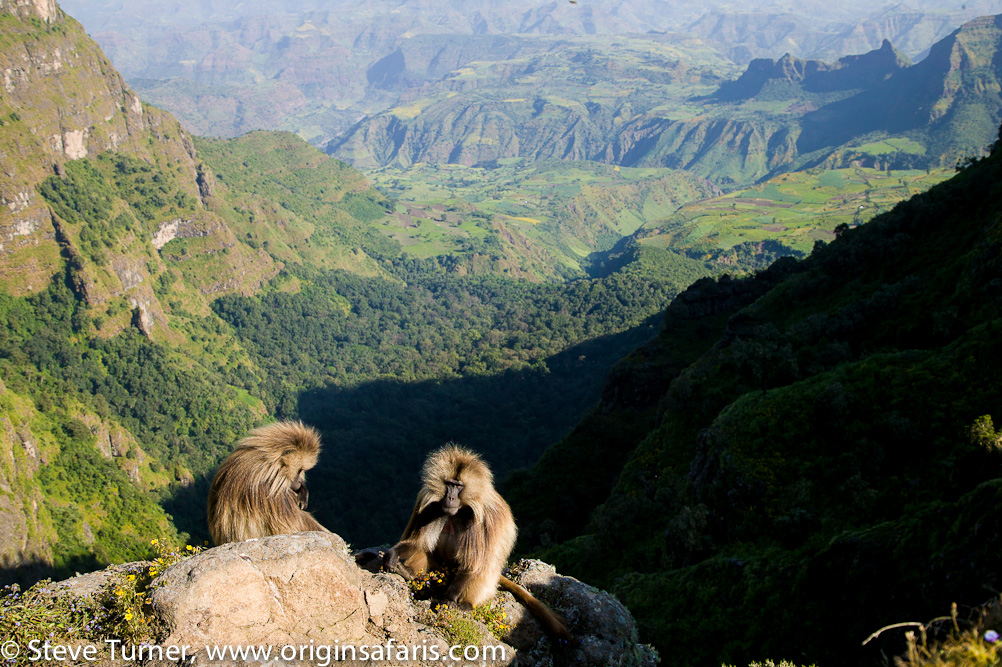
The plateau is home to probably the main attraction of the Bale Mountains National Park, the Ethiopian Wolf. Approximately half of the world’s population live in the Sanetti Plateau area. For such a rare creature it is amazing that they are so readily seen. The wolf has especially adapted to living on the high altitude plateau and its prey is the abundant rodent population, many of which are endemic themselves, including the Blix’s Grass Rat and the Giant Mole Rat.

For bird enthusiasts, species on the plateau include the most northerly breeding pair of Wattled Cranes, Golden Eagle, Lammergeiers, near endemic Rouget’s Rail, and the endemic Black Headed Siskin, Thekla Lark and Blue Winged Goose.

RWANDA
Rwanda, known as the “Land of a Thousand Hills”, “Singapore of Africa” or “Switzerland of Africa.” Upon entering the country, you will find rolling hill after rolling hill covered in farmland or tea plantations that make way for dense jungles, vast lakes, and massive volcanoes topped with snow. It’s one of the greenest and hilliest places, the scenery so beautiful and the surroundings cleaner than anywhere else in Africa, and much of the rest of the world, for that matter.

This little gem of a country in the middle of equatorial Africa is a watershed between Africa’s 2 largest river systems, the Congo and the Nile, Rwanda is a mountainous country with a moist tropical climate all year round. All the greenery and water makes it home to some amazing wildlife and forests. The most notable and biggest tourism driver is the endangered Mountain Gorilla. Found in the Parc National des Volcans on the border of Uganda, this park incorporates Rwanda’s slice of the Virunga Mountains.
Walking With the Apes
Mountain Gorilla trekking is one of the most exhilarating safari tours and moving experiences you can have with Origins Safaris. You can get so close to these giant primates, observing them observing you. Their human-like movements, innate dignity and social interaction create a unique connection within each of us.
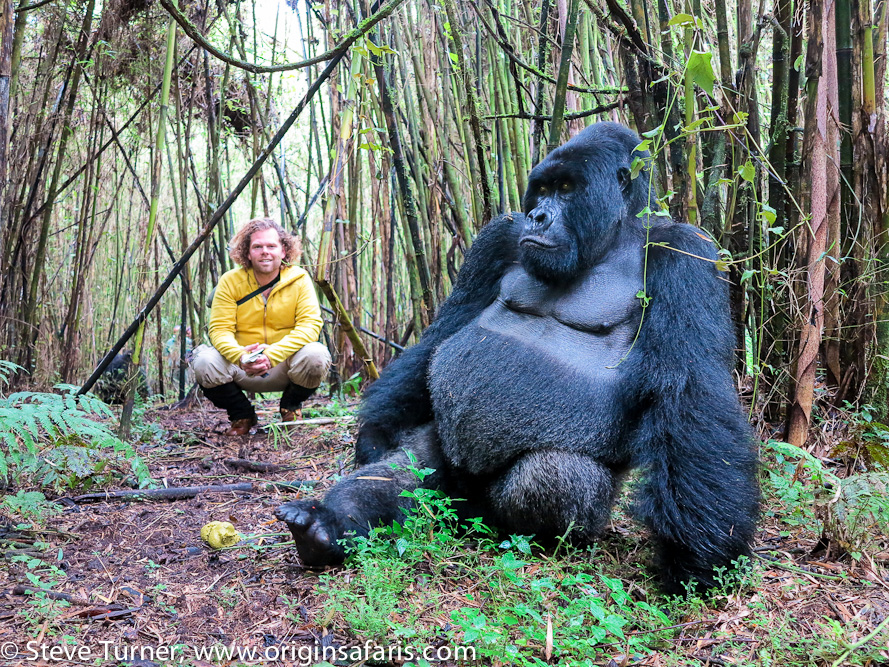
Gorilla trekking only takes place in the DRC, Uganda, and Rwanda. With less than 1,000 gorillas left in the wild, it’s a rare opportunity to see this majestic primate up close. Seeing wild mountain gorillas is one of the top travel experiences you can do. The trek is manageable, but the steep inclines test your strength and stamina as you make the arduous ascent with your walking sticks, leaving you breathless (at an altitude that can reach 2,499m, this is normal).

If you are lucky you won’t have a long walk to see the gorillas. When you finally do see them, silence will fall among your group of trekkers. Spines will tingle. The gorillas don’t seem to mind your presence, the silverback, the patriarch of the troop, is a behemoth — intimidating even as he rests peacefully. But the fear quickly subsides as you watch restless youngsters climb from their mother’s shoulders onto the silverback in exactly the same way your relatives may have done as toddlers with their own parents.

Golden Monkey Trekking in Volcanoes National Park
Other fascinating primates found here include the gorgeous Golden Monkey. These rare species are also listed as endangered – and Volcanoes National Park currently has two habituated golden monkey troops that are available for visiting by tourists in the park, both of which make about 80 members. Trekking Golden Monkeys and mountain gorillas is a similar experience – in a small group of no more than eight people, and you can spend one hour with the monkeys once you find them. They are very active creatures, and jump from tree to tree which is really interesting and a little difficult to photograph! A golden monkey trek is worth going for while in Volcanoes National Park and if you’re interested in wildlife, this is a rare and delightful experience not to be missed!

Chimpanzee Trekking in Nyungwe Forest National Park
Located in the south west corner of Rwanda, Nyungwe Forest National Park is an untouched and natural rainforest that is filled with exciting biodiversity. Covering over 1,000 km2, Nyungwe is surely one of the world’s most beautiful and pristine mountain rainforests. It’s believed to be one of Africa’s oldest forests, staying green even through the Ice Age, which explains its diversity. Nyungwe Forest is the largest montane forest in Central Africa. Home to habituated chimpanzees and 12 other primate species, including a 400-strong troop of Ruwenzori Black & White Colobus, it is also a birder’s paradise with over 300 species, including 16 endemics, and is home to 75 different species of mammal.
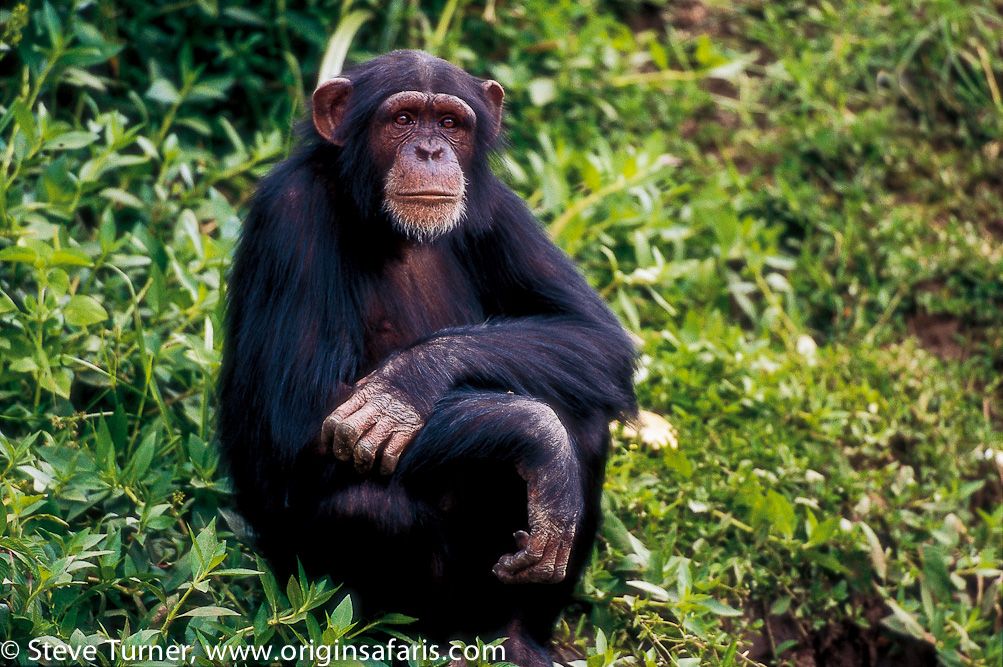
This majestic rainforest is filled with nature and wildlife experiences for you to emerge yourself in. Hiking and tracking the famous chimpanzees, experiencing the canopy walk, witnessing beautiful birds and relaxing by waterfalls are just a glimpse of activities that Nyungwe offers.

Chimpanzee trekking is a must-do when in Rwanda, considering that they’re only found in central and west Africa and sadly, their numbers are dwindling. The trek starts at 5am, it is early but the forest is already bright-eyed and prehensile-tailed. The atmospheric mists cloak the forest, highlighting leaves origamied by hungry ants and dewy cobwebs that glisten among the high trees and grasses. Since the chimps nest each and every night, there are trackers who go ahead of the trekking group to finding them and communicate with the ranger guides. Once your group finds them, you will encounter them running around you through the forest, calling to each other and swinging from the trees. It is quite the sight! Though you will have to move quickly to find them and stay with them, it is worth it to see a family hanging out together, eating fruit, and enjoying the beautiful jungle.

UGANDA
In his book “My African Journey” published in 1908, Winston Churchill commonly referred to Uganda as the “Pearl of Africa” when describing his Safari to Uganda in 1907. This is how Uganda obtained this great tag.
Straddling the equator, Uganda is a landlocked country in East Africa with motley landscapes, from savanna plains to mountain peaks to untamed jungles, as well as a wealth of diverse and rarely seen wildlife. Uganda is one of East Africa’s better kept secrets. In the past its tourism strengths have been often ignored in favour of its sexier neighbours, but the fact is that Uganda has it all: remote wilderness areas, breathtaking scenery, extraordinary cultural diversity and incredible wildlife.
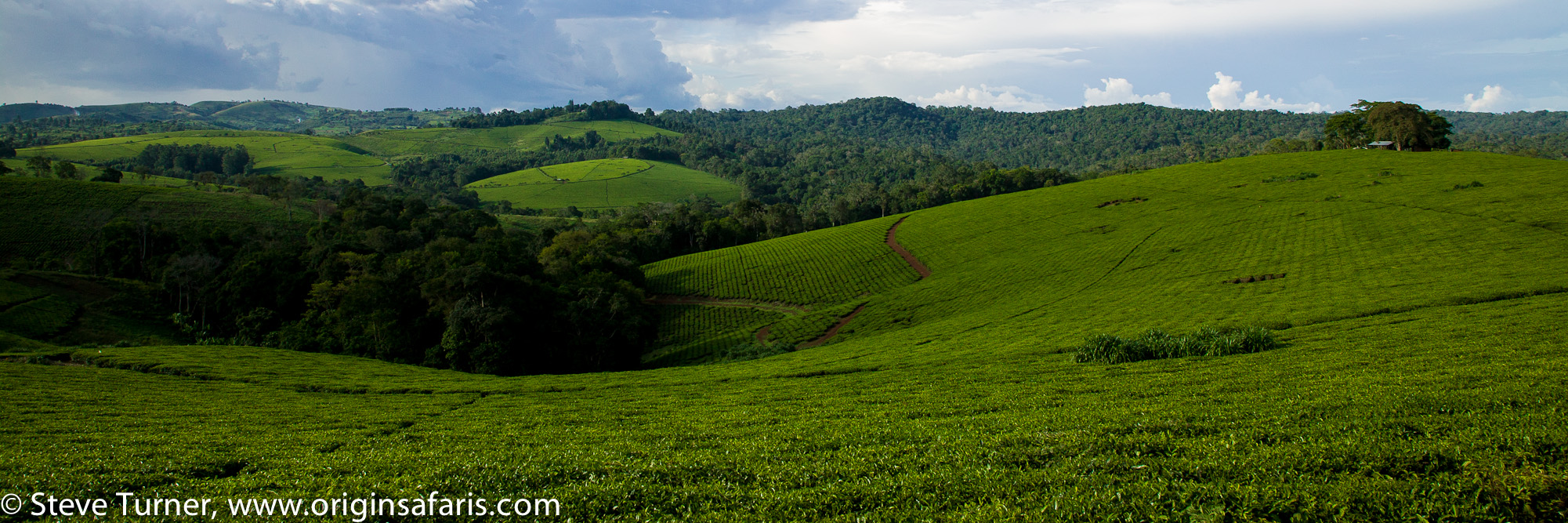
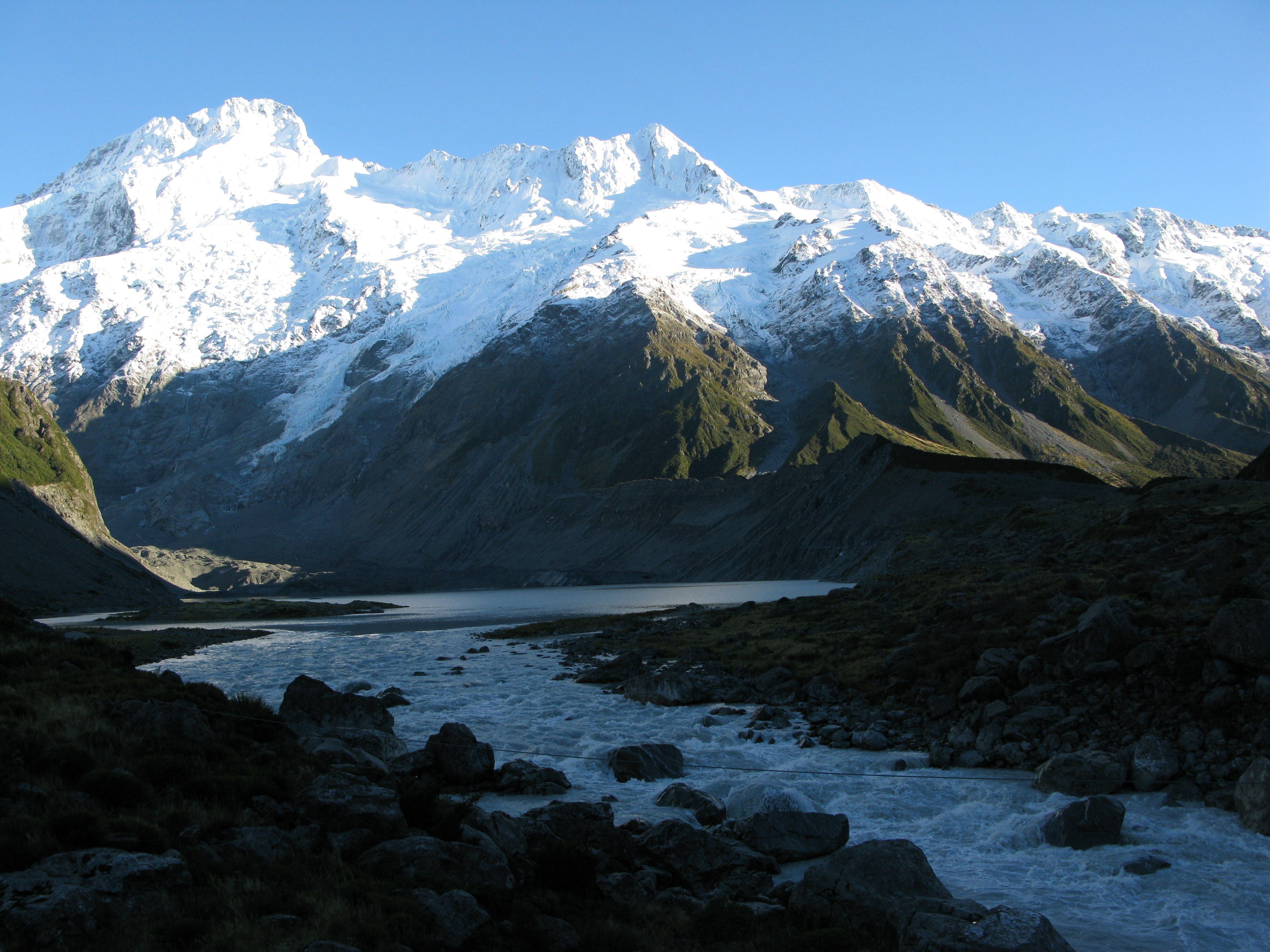
Uganda is a lush and green country. The country’s dominating feature is water: the vast blue of Lake Victoria, the ever-flowing river Nile, Lakes Edward, George and Albert, and the expansive network of wetlands and marsh. Dramatic mountains punctuate the landscape: the snow-capped Rwenzori Mountains (Ptolemy’s famous ‘mountains of the moon’), the volcanic ranges of the southwest, and the massive Mount Elgon in the East of the country.
Uganda is best known for its primates – the mountain gorillas, based in the Bwindi Impenetrable National Park and our closest relatives- the chimpanzee in Kibale National Park is without doubt one of the ‘must do before you die’ experiences for any wildlife aficionado.

Mountain Gorilla Trekking
The Bwindi Impenetrable Forest is an ancient rainforest that extends over a series of steep ridges in the Virunga Volcanoes mountain range. Declared a UNESCO world heritage site due to its ecological uniqueness and natural beauty, roughly half of the world’s total population of Mountain gorilla live in the park. Its impenetrable nature is due to the dense growth of herbs, vies and shrubs that cover the valley floors, this makes it the ideal habitat for mountain gorillas. The park protects an estimated 320 mountain gorillas. Of that, nine gorilla families (each family usually consists of 10-15 members) have been habituated. Viewing is strictly controlled to ensure the sustainability of the gorillas. Strict rules must be followed to prevent behavioural disturbances and the transmission of diseases from humans to gorillas. (Even a common cold can be fatal to a gorilla).

The rugged terrain makes trekking gorillas’ strenuous work. The exercise involves walking through thick forest up steep and slippery slopes. Mountain gorillas cover long distances each day and so tours can last anywhere between 3-9 hours.
Chimpanzee Trekking in Kibale National Park
Kibale National Park covers an area of about 795km and it is acknowledged to have one of Uganda’s most gorgeous tropical forest. It is home to a multitude of forest wildlife, most especially, the forest supports one of the highest primate densities in the world, including chimpanzees, red colobus, black and white colobus, red tailed monkeys, blue monkeys, ververt monkeys, l’hoests monkeys, great cheeked mangabey and olive baboon.

Chimpanzee trekking in Kibale National Park is truly an amazing experience and is the best place to track chimpanzees in Uganda. The park has the largest population of chimpanzees in Uganda with over 1,500 chimps and there are three big communities of chimps that have been habituated for tourism which is more than any other place in East Africa. Chimpanzee trekking in Kibale National Park provides a unique opportunity to get into the lives of our closest relatives with whom we share 98.7% of our DNA. Like humans, chimpanzees live in complex societies, solve complicated problems, make and use tools, engage in elaborate interactions and communicate through a variety of sounds and gestures. Every chimpanzee trek is always a unique experience; there is no telling where the chimpanzees will lead you. Their movements are unpredictable – whether it is uphill, downhill or on even ground, you will follow the agile group, sometimes at challenging speeds through dense vegetation, for rare, up-close encounters.
Trekking the ‘Mountains of the Moon’
Trekking the mystic Rwenzori Mountains National Park in Uganda is a fantastic and unparalleled experience; the wonder of the high glaciers, the beauty of the valley of nine lakes, the bearded lichen hanging from giant heathers with a backdrop of rocky cliffs, crags and snow capped peaks. The wide variety of flora and fauna with several biospheres as you ascend through different vegetation zones creates the ultimate experience for trekking. Never before has this unique and beautiful trek been available, totally untouched and undoubtedly one of the most beautiful treks in the world.

The Rwenzori Mountains is a World Heritage Site and offers the opportunity to see nature at its best. The plant life varies from heavy tropical rainforest, bamboo forests, and montane cloud forests to alpine vegetation. The scenery is truly spectacular. Above 4,500 metres the snow and glaciers add that special dimension to the wondrous views throughout this pristine mountain range.
Murchison Falls National Park
This is Uganda’s largest national park (3,840km2), and is one of the high points of ay visit to Uganda. Murchison Falls National Park is named after the dramatic Murchison Falls, where the Nile explodes violently through a narrow cleft in the Rift Valley escarpment to plunge into a frothing pool 43m below.

Uganda boasts 11% of the world’s largest concentration of bird-life, making it an ornithologists’ haven for identifying one of the largest concentrations of bird-life, and Murchison Falls National Park is no exception. The park is home to 442 bird species. You may be lucky to see one of the greatest rarities of all: The Shoebill. Walking and exploring the banks of the Nile with our certified resident bird expert, who to the date can identify over 200 bird species by sight and sound, and he is looking to identify the rest.

A boat trip to the bottom of Murchison Falls is a must activity when visiting the national park. It is a leisurely adventure where you will have the chance to see hippos, crocodiles, elephants, a variety of antelopes, as well as the rich-bird-life inhabiting the river’s papyrus-lined banks.

About Origins Safaris
At Origins Safaris we are passionate about wildlife, cultural heritage, adventure and exploration. We customize each and every safari to your personal requirements and expectations, ensuring an exclusive, unique and authentic experience every time.
Origins Safaris is a family business, founded in 1963 by Don and Margaret Turner. It is managed today by two subsequent generations of the family, and predominantly by Don’s son, Steve. We are so much more than just a travel broker – our years of experience, professionalism and reliability means that we go the all important extra mile, to make sure your dream safari is safe, memorable, educational and most of all great fun. We are renowned for our meticulous safari planning from start to finish, and the highest standards of natural history.
Origins Safaris provide that crucial “sound advice and impeccable service” so seldom found by other companies. We have 50+ years of authentic African safari experience and the know-how to make your trip run as smoothly as possible. Use our website (www.originsafaris.com) to find the trips that inspire you and add them to your bucket list. As you use the arrows to browse through the various countries we do safaris to, bear in mind that the further you go into the website the more adventurous, specialized and remote the trips become. We are offering you a lifetime of travel, beginning with the easiest and ending with the hardest as you find your Africa feet and wish to do more exciting trips.
If you would like to travel to Rwanda specifically and experience some or all of the amazing attractions highlighted above, please contact us on the following: https://originsafaris.com
Origins Safaris – Authentic African Experiences Since 1963


 STEVE TURNER
 SELEMPO EDWIN LESOINE
 STANLEY KARITHI
 ZACHARY METHU MBUTHIA
 PETER LIECH ADEDE
 FELIX WAMBUGU
 JOSHUA SONKOYO
 HENRY MIWANI


